What is wind foiling? 12-most-frequently-asked-questions-answered Wind foiling, feeling able to fly The Foiling Revolution This Is Why I Started Wing Foiling -BEYOND THE REEF -The Early promise -Windsurf foiling and wing foiling: 5 differences between the two awesome activities. -The Best Places to Wing Foil in the United States -WingFoil Schools Worldwide -How to choose the right equipment for Wing Foiling (Beginner Version) -Choosing Your Wings: A Guide to Wing Foil Wimg Sizes -What Is Wing Foiling? -What is foiling anyway?
|
| The Early promise |
 |
Kjell: So Sky, KenÉ take me back to how you both found yourselves in water sports.
Sky: I grew up in a family where my first memories were made on the beach windsurfing with my parents. I've always been around water sports. Luckily, I've been able to follow a path that allows me to do this as a career. It's something I'd definitely be doing even if it wasn't my job. Like you said, it's a lifestyle and something I do to keep myself happy and fit. Hopefully I'll keep on doing it for a long time!
Ken: From my side, I grew up sailing. My dad had boats. He bought them, worked on them, and sailed them. When I was about 20, I started windsurfing and that's how I got my sailing fix from then onward. It's been an interesting journey from windsurfing to kiting, with the occasional excursion into SUP surfing and surf foiling, and then on to wing foiling. I find that surf, downwind, and kite foiling are fairly difficult. Wing foiling is pretty easy in comparison, so I think foiling will experience its greatest growth with the addition of the wing.
Kjell: Given that, how does foiling fit into your routines?
Sky: It's been an amazing addition to my quiver of toys for the last few years, that's for sure! All the days when we'd go to the beach and the wind and waves weren't that good, you could only go out and do big airs for so many hours before getting bored. I found myself always waiting for those really good wave days - those are the days I live for - and now with foiling I'm pretty much guaranteed to get in a good session no matter the conditions. When there's no wind and small waves, I go surf foiling. If it's blasting wind but no surf, I'll do a SUP or wing foil downwinder. It's just added so much fun and variety to everyday conditions. That translates really well for everyone. We live on Maui where we're blessed with pretty good conditions all the time, but for people whose local spot is a lake without the most exciting conditions, they can pick up a wing foiling setup and are basically guaranteed to have fun.
Ken: I agree with that. Foiling has been an amazing addition to watersports, and if I were less busy I'd take some time to improve my downwind foiling abilities. Of course, since I'm in the business of designing wings for wing foiling, I'm usually working on those. I typically ride the same hydrofoil day-after-day with wing testing, so I don't explore too much there. It's nice to know I can get a single hydrofoil and it'll work for a lot of different activities.
Kjell: Ken, you mentioned earlier that wing foiling brings a new level of accessibility to wind sports. Part of what excites me is seeing people come from surf foiling to wing foiling (like myself) and often discovering wind sports that way. Considering how many times you've been at the genesis of a wind sport, do you think wing foiling's just a step in the evolution of board riding or is it something more?
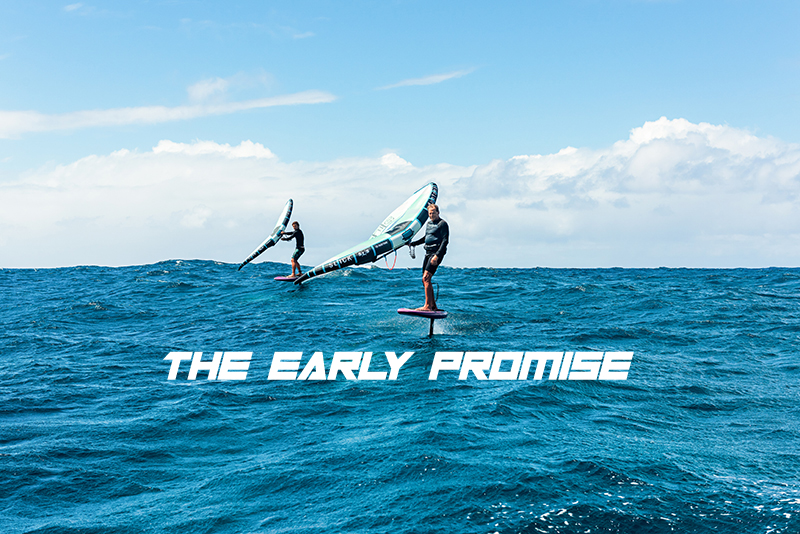
Ken: I think it's going to be around for a long time, partly because there are people of all ages doing it. Kids are getting really good really quickly. It's encouraging to see entire families doing it here on Maui in the Kahului Harbor. It brings us back somewhat to the early promise of windsurfing when it was something really revolutionary for its time, something that people enjoyed doing in relatively mild conditions and evolved to become more exciting in bigger conditions. Wing foiling achieves that excitement level that people crave, but it does so in conditions that are much more commonplace. You don't need rough water or strong winds to enjoy the magic of flying over water, so the fact that it's exciting yet accessible means it'll remain popular and durable.
Kjell: Sky, thinking in line with the family-friendly aspect of foiling that Ken just put quite concisely, what's your view on how foiling has transitioned from this pointy-edged, razor-sharp, high speed thrill ride discipline into something you'd feel comfortable putting your family on over the weekend?
Sky: As the sport evolves, people's perception is changing. The first time I saw foiling was when I came to Maui in 2000. Laird and Dave Kalama were towing into big waves at the time, and it just looked crazy, like something out of Mad Max. With those big boots on, it looked so inaccessible and extreme that I didn't even want to try it at the time. In the early days, that was the perception: next level and not attainable by mere mortals! Clearly, that's changed over time as the gear has evolved and gotten much lighter and more usable. Now the corners are rounder and the foils are lighter. It's just to a point where it's benign. Those details have made all the difference in the world, I think.
Kjell: You both have such an influential role in shaping all these factors that make the sport more attainable. Is accessibility always the primary goal when you're designing new boards and wings? How does that relate to performance?
Ken: I'd always found that people were afraid of the risks associated with the foil itself, so I designed a kite hydrofoil that had no sharp edges and almost nothing to get hurt on. It ended up being a commercial failure because it turned out most people aren't that worried about getting hurt! The risk for most people isn't that great with some basic precautions. So, if the market demands a really safe hydrofoil, the design is already there. In fact, a French company (Decathlon) took the idea I had Ð not sure if that's been a commercial success or not Ð connecting the front wing to the back wing at the wingtips with a bar. Basically, if you fall on it, it's more like a falling on a surfboard rail than a knife. The issue of accessibility is a prominent one, and we're always working to give people the things they want and need for their level of ambition and ability.
Kjell: Yes! I remember that foil you made at North, but I forget what it was called?
Ken: I don't remember eitherÉbut I should mention I went a step further and positioned the foil so that it could work with existing kite foil boards with boxes that were positioned at the rear of the board. I went to every extreme to make it something people could just step right onto and use with minimal risk. We learned that going to such lengths to improve safety is not really desirable for now.
Kjell: Pivoting to board design Sky, what was it like for you to come from shaping planing boards to hydrofoil boards with contours designed to stay off the water?
Sky: It was pretty cool, actually. It opened up a lot of possibilities to do whatever I wanted with shapes and contours. We ended up finding that boards make a lot bigger difference than we initially thought. At the time, Ken designed the first few prototype wings and we had existing SUP foil boards that automatically became the first wing foil boards. They tended to be pretty big. I think my board at the time was 6'3 x 28" wide, maybe 110 liters. We quickly learned that we could go a lot smaller than that. The first dedicated wing foiling board I made was back around 2018 or so, and it was 5'2 x 22" and 55 liters. Back then, it was tiny and seemed almost too small to ride. The year after, we launched our first production wing foil boards with Fanatic. It's come a long way. Next year, we're launching a range that goes all the way down to 4'2, starting at 20L and topping out at 140L with 10 liter increments in between. It's been interesting to see how much we've progressed in just four years, starting with really crazy double concaves to see what we could get away with, and over time refining it back after realizing that too many things added drag. Bevels and step tails are great for reducing catching when touching down, but you also need glide and the ability to get up on foil. It's a balance and has brought things back down to reality where the boards are looking just a bit more normal than two years ago.
Read more at source. |
Source: |
See more at source: |
|